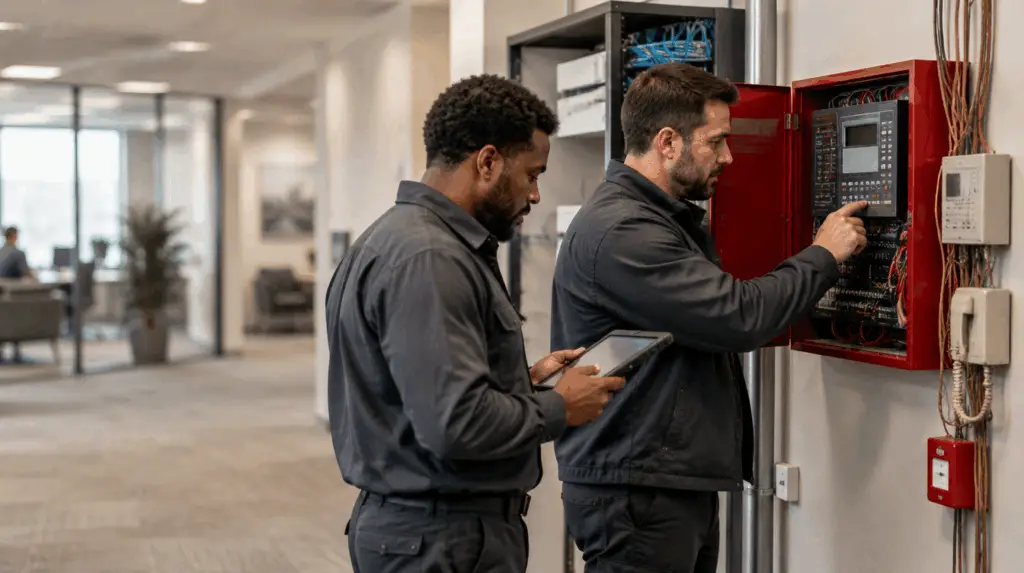
Copper retirement is no longer a distant network story. It is an operating deadline for the teams responsible for fire alarms, elevator phones, security panels, emergency call stations, fax machines and other analog equipment.
On September 9, 2026, Verizon and operating companies acquired from Frontier asked the Federal Communications Commission for authority to discontinue copper based legacy voice service in portions of California, Connecticut, Illinois, Maryland, Massachusetts, Michigan, New York, Pennsylvania, West Virginia and Washington DC. The FCC has assigned the matter WC Docket No. 26-252. The application proposes discontinuance on or after November 30, 2026, subject to federal approval and any additional state requirements.
The filing covers residential and business service. If a critical building system still depends on a Verizon or Frontier copper line in one of the covered areas, now is the time to identify it and build a controlled migration plan. November 30 is the earliest proposed date, not a universal shutoff date, but waiting for a site specific disconnection letter leaves less room to survey, install and test the replacement.
Key facts
- Who filed: Verizon entities and operating companies acquired from Frontier, identified in the application as Verizon companies.
- Where: Portions of California, Connecticut, Illinois, Maryland, Massachusetts, Michigan, New York, Pennsylvania, West Virginia and Washington DC.
- How many locations: Verizon says its network could serve more than 28 million locations in these areas and that approximately 750,000 residential and business locations, or 2.7 percent, still subscribe to copper based legacy voice service.
- When: On or after November 30, 2026, subject to FCC approval and any additional state requirements. That date is a regulatory milestone, not a promise that every affected line will disconnect that day.
- Customer notices: Initial notices were mailed September 8, 2026. Verizon says customers selected for discontinuance will receive another letter with a specific date. Any earlier notice already received may still control.
- Where it applies: The request is limited to locations where Verizon says a qualifying replacement service is available.
- Current status: The matter is active in FCC WC Docket No. 26-252. Comments and other filings are part of the public record, and the status can change as the FCC reviews the application.
What the carrier is offering in place of copper
The application identifies several kinds of replacement service that may qualify at a location:
- Verizon fiber voice service.
- Verizon fixed wireless home phone products, including Voice Connect and Verizon Voice Gateway, which connect existing telephone equipment to the Verizon wireless network.
- Verizon mobile wireless service.
- Fiber, cable or mobile voice from one of ten named providers: AT&T, T-Mobile, Xfinity, Spectrum, Breezeline, Mediacom, Optimum, Shentel, Sparklight or Armstrong.
For a household voice line, one of those options may be a reasonable fit. A business line supporting critical or legacy equipment needs a more specific evaluation. According to the application, Voice Connect provides up to three hours of talk time or 23 hours of standby time on AA batteries, while Voice Gateway provides up to four hours of talk time or 24 hours of standby time. The customer is responsible for obtaining and maintaining the batteries, and the device does not work without utility power or usable backup power. A mobile phone is likewise limited by its battery and network availability.
That does not make these products bad. It means availability of a voice substitute at an address is not the same thing as a complete migration plan for every device connected to the old line.
Why business lines need a different plan
Most copper lines still found in commercial buildings are not there for everyday conversation. They often sit behind:
- Fire alarm communicators
- Elevator emergency phones
- Security and burglar alarm panels
- Emergency and blue light call stations
- Fax machines, modems and other analog endpoints
A failure can be silent. When a desk phone fails, someone usually notices. A communicator that stops reporting can remain out of service until a test, an inspection or an emergency. Critical lines need active visibility, not hope.
One path is still one point of failure. A single wireless radio on a single network does not create resilience by itself. The right design depends on the application, the site and the available connectivity.
Backup power has to be managed. A battery is useful only if it is correctly sized, installed, monitored and maintained. That becomes an operating challenge across 20, 200 or 2,000 locations.
Fax and modems are sensitive to the network path. Packet based networks can introduce compression, latency and jitter that interfere with analog tones. A replacement should be designed and tested for the actual endpoint, not assumed to work because it provides dial tone.
Your vendors and local authority still matter. Before moving a fire panel, elevator phone or other regulated system, coordinate with the alarm monitoring company, elevator service provider and the authority having jurisdiction. Requirements and acceptance processes vary by system and location.
How TELCLOUD replaces copper for critical systems and fax
TELCLOUD approaches POTS replacement as a managed service, not a box drop. POTSCAST connects to the last foot of copper already serving the endpoint, while the service adds modern connectivity, remote management and operational support behind it. The goal is simple: keep the alarm, elevator phone, fax or other analog device doing its job without turning the customer into a telecom engineer.
- Works with existing equipment. POTSCAST is designed to connect to legacy analog endpoints, including fire and security alarms, elevator phones, emergency phones, fax machines and modems.
- Multi path connectivity. TELCLOUD uses a Multi WAN architecture that can combine available IP and wireless paths, with the design matched to the site and application.
- Managed backup power. Battery backup is part of the deployment plan and is configured for the selected equipment and operating requirements.
- 24 x 7 x 365 visibility. TELCLOUD provides remote monitoring and alerts through its Network Operations Center so connectivity issues can be identified and addressed.
- Support for demanding analog traffic. TELCLOUD designs around the signaling, modem and fax behavior that generic voice services can struggle to carry reliably.
- A fully managed lifecycle. TELCLOUD can support the survey, equipment, installation, activation, monitoring and ongoing service through its channel partners.
The work starts with discovery. The team confirms what each line serves, how the endpoint is wired, what connectivity and power are available, and who needs to witness testing. From there, the replacement can be installed, tested with the responsible vendors and monitored after cutover.
What to do now
- Inventory every copper line. Record the location, account and circuit information, endpoint, monitoring destination, responsible vendor and current monthly cost.
- Separate critical lines from ordinary voice. A fire panel, elevator phone, fax machine and lobby phone may all use an analog jack, but they do not have the same technical or compliance needs.
- Watch for carrier notices. Keep both the initial letter and any follow up notice with a site specific disconnection date. Check earlier notices as well.
- Start before the deadline. Site surveys, scheduling, permits, vendor coordination and acceptance testing take time. Do not treat November 30 as the day to begin.
- Bring alarm, elevator and facilities vendors in early. Confirm who will test the endpoint and what documentation or signoff is required.
- Test before canceling. Verify calls, signals, supervision, failover and backup power as applicable. Cancel the old line only after the replacement has passed the required tests.
- Use the FCC docket for regulatory status. WC Docket No. 26-252 is the public record for this application. The filing covers portions of the listed states, not every address in each state.
FAQ
Which areas does the filing cover?
Portions of California, Connecticut, Illinois, Maryland, Massachusetts, Michigan, New York, Pennsylvania, West Virginia and Washington DC. The application includes maps of the proposed service areas. It is not a blanket statewide shutoff.
When will my copper line be shut off?
The application proposes discontinuance on or after November 30, 2026, subject to approval and other applicable requirements. That is the earliest proposed date. Customers selected for discontinuance should receive a separate notice with their specific date.
Is my line definitely affected?
Not simply because it is in one of the listed states. The request applies in specified areas and only where Verizon says a qualifying replacement is available. Confirm the status of the exact service address and retain every carrier notice.
Can a home phone replacement run my fire alarm or elevator phone?
Do not assume that it can. The application says the carrier options support many legacy alarm systems, not every system or use case. Confirm compatibility, backup power, network resilience, monitoring and acceptance requirements with the system vendor and local authority.
We are not in these states. Does this still matter?
Yes. Copper retirement is happening carrier by carrier and market by market. Separate 2026 proceedings cover additional states, and the FCC has shown that each application can take its own path. Any organization with analog lines should inventory them now rather than wait for a disconnection notice.
Do we have to replace the fire panel or elevator phone?
Often, no. A properly designed POTS replacement can connect to existing analog equipment through the last foot of copper. The site survey and application testing determine what can remain in place and whether any equipment changes are needed.
Copper will retire on the carrier’s schedule. Your migration should happen on yours.
If your customers or facilities still depend on copper, start with an inventory and a site plan. Talk with your TELCLOUD partner or contact TELCLOUD to plan a managed POTS replacement before a disconnection date turns a manageable project into an emergency.